Our why
We measured the problem before we built the fix.
Managent exists because concurrent AI coding agents are already colliding in production, and until our study, no one had measured how often. We analyzed 33,596 agent-authored pull requests across 2,807 repositories, replayed 747 real merges with git merge-tree, and published the results on arXiv. This is the empirical gap that led us to build coordination infrastructure.
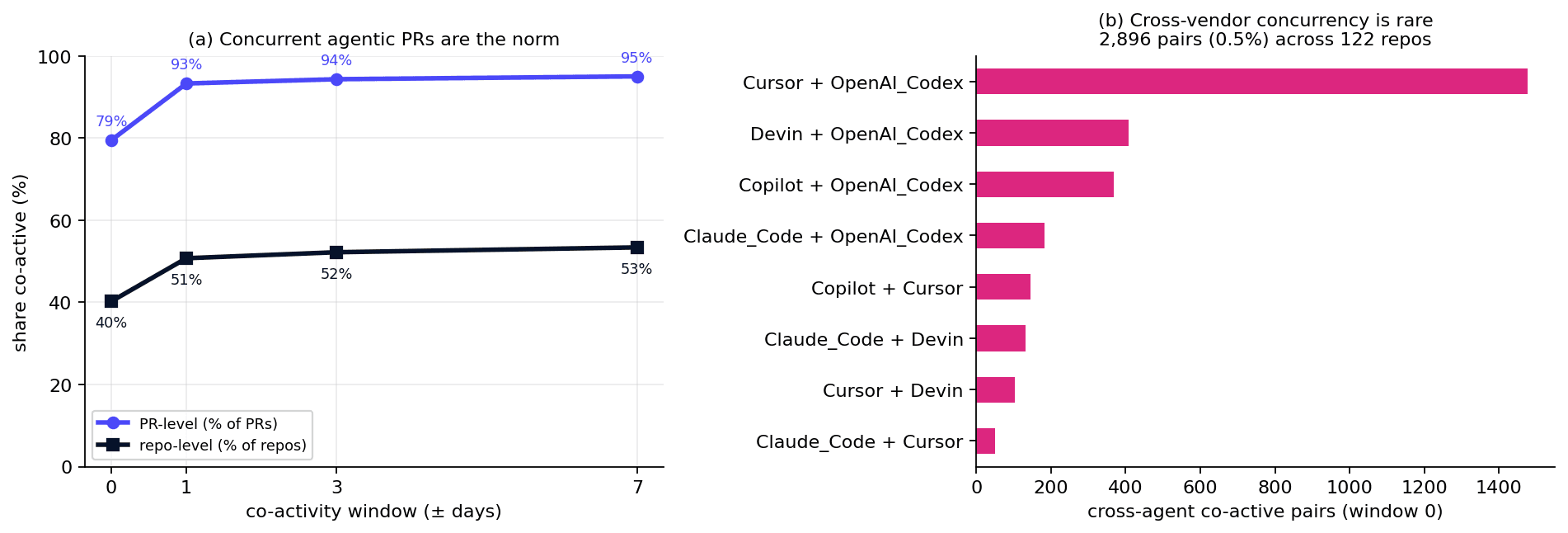
79.4%
of agent-authored PRs are open concurrently with another agent PR
Exact temporal overlap (k = 0) across the AIDev-pop corpus.
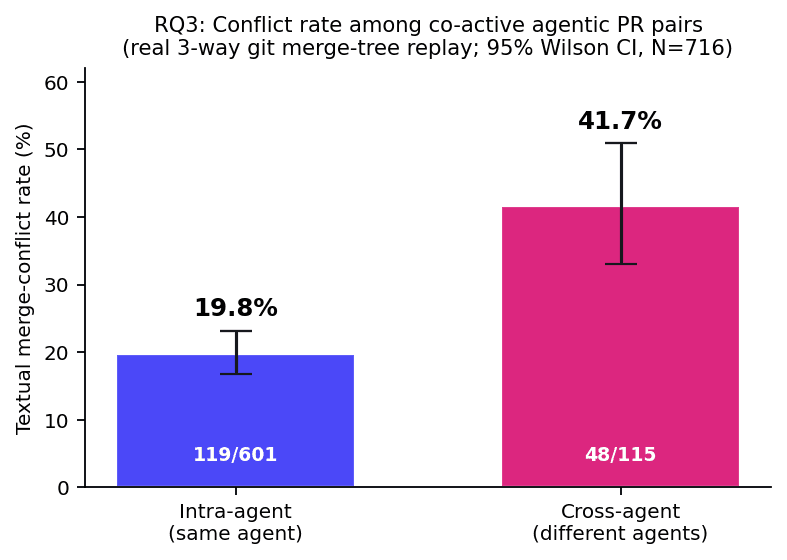
19.8%
textual merge conflict rate among same-agent co-active pairs
601 evaluable pairs from a 747-pair git merge-tree replay.
41.7%
textual merge conflict rate among cross-agent co-active pairs
Roughly double the intra-agent rate; 95% Wilson CIs do not overlap.
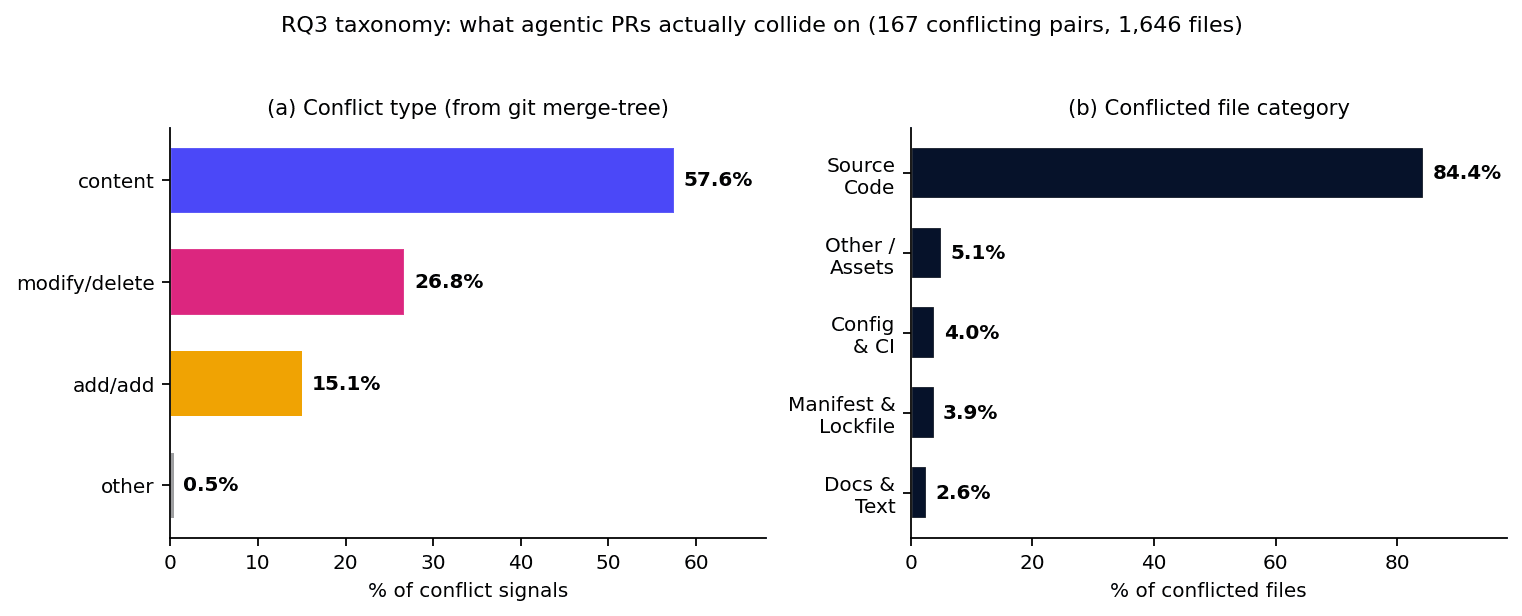
84.4%
of conflicted files are source code, not lockfiles
42% of conflicts are structural (modify/delete or add/add).
Study findings from arXiv:2607.04697 — academic conflict rates from the paper, not Managent deployment residual rates or verification_runs.
Enforcement status (MVP)
Today’s product is advisory lease + drift detection + merge-replay verification. Agents that respect leases do not write the same paths concurrently; PR-time drift catches scope misses; git merge-tree verifies coordinated pairs. That is not an OS or filesystem sandbox — out-of-territory writes are not blocked at the kernel level in MVP (filesystem-level enforcement is a later milestone).
Honest limitations
- Conflict-freedom holds within respected leases; a misbehaving client can still write outside its lease until stronger enforcement ships.
- Residual textual conflicts and lease violations are measured from
verification_runs, not estimated — and are separate from the paper rates above. - Structural conflicts (modify/delete, add/add) and build/semantic failures are outside the textual merge-replay claim.
- No SOC 2, SLA uptime, or OS-sandbox guarantees — we do not invent compliance claims or filesystem-level enforcement here.
The gap we set out to close
Prior work measured whether a single agent PR conflicts with its base branch. Nobody had asked the collaboration question: when two agent PRs are open at the same time in one repository, how often do they conflict with each other?
Using the public AIDev-pop dataset, we formalized temporal co-activity across expanding overlap windows, stratified intra-agent vs. cross-agent pairs, and replayed three-way merges at scale. The conflict rates we report are conservative lower bounds: they capture textual-layer friction only, before build or semantic failures.
| Window (k) | PRs co-active | Repos co-active |
|---|---|---|
| 0 | 79.4% | 40.2% |
| ±1 day | 93.3% | 50.7% |
| ±3 days | 94.3% | 52.2% |
| ±7 days | 95.0% | 53.4% |
Figures from the paper
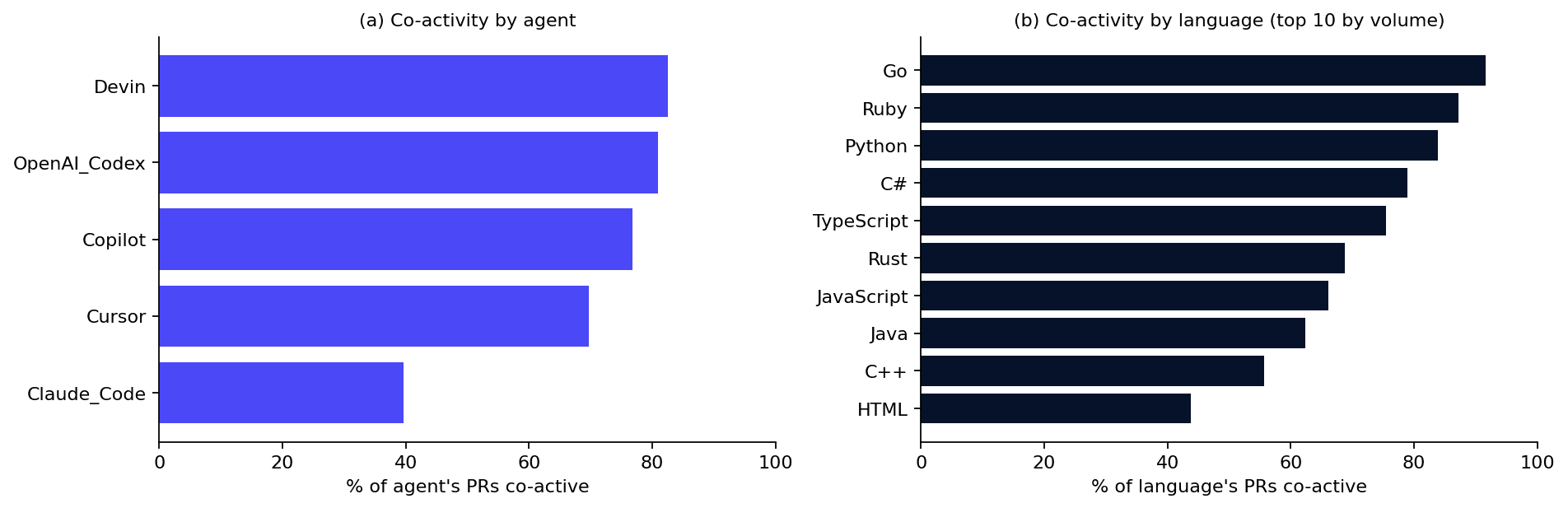
Four research questions (frequency, composition, collision, and association), distilled into the charts below. Full methodology, threat-to-validity discussion, and pair-level replication data are in the paper.
From findings to product
The study concludes that uncoordinated reactive development cannot support fleets of autonomous agents. Agents today lack even basic horizontal awareness. The dominant concurrency mode is a single agent platform opening multiple PRs in parallel, and one in five of those pairs already conflict at the textual layer.
Managent is our answer: exclusive leases, a visible queue, webhook-driven handoffs, and merge-replay verification — still advisory plus drift plus verify in MVP, not a filesystem sandbox. It uses the same merge-tree methodology we used in the paper, now running on your repo. Watch a captured replay →
Authors
- Arjun Subramanian · MIT CSAIL
- George Xu · Harvard Medical School / MGH
- Nithilan Karthik · DevRev AI
AI Agent Pull Requests on GitHub: Frequency, Structure, and Merge Conflict Rates · arXiv:2607.04697
We onboard a few fleets each week, in order of request.